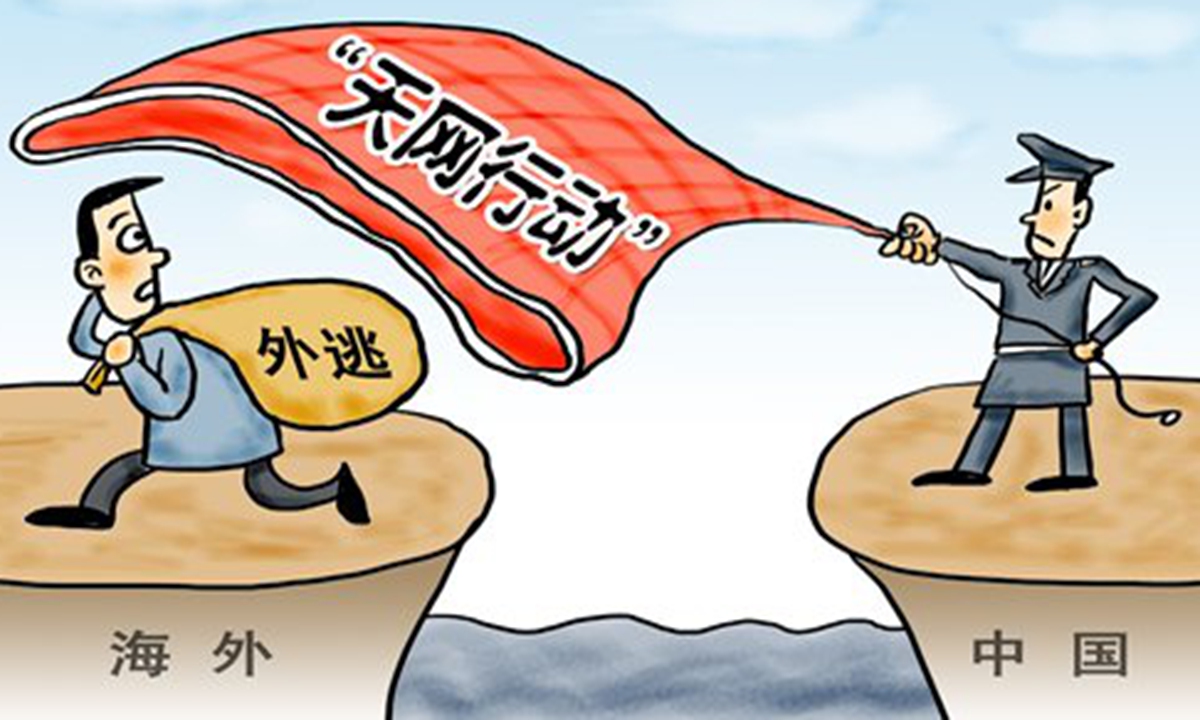
An animated picture features Chinese law enforcement official tracking back a fugitive who flees overseas with his ill-gotten asset during the Skynet operations, China's project to track down fugitives. Photo:VCG
Chinese lawmakers began reviewing a draft law on combating cross-border corruption on Tuesday, a legislation which experts believe would help close legal gaps in investigating overseas corruption, pursuing fugitives and recovering illicit assets, while strengthening international cooperation and corporate compliance.
The draft was submitted for its first reading to the ongoing session of the Standing Committee of the National People's Congress, the country's top legislature, per Xinhua News Agency.
Huo Zhengxin, a professor at the China University of Political Science and Law, told the Global Times that the draft law represents a dedicated piece of legislation within China's anti-corruption legal framework and a major step forward in the country's law-based governance of foreign-related affairs. It will fill a legislative gap in combating cross-border corruption, Huo said.
As Chinese companies expand business overseas, cross-border corruption cases face challenges in obtaining evidence abroad, pursuing fugitives and recovering illicit assets. Existing anti-corruption laws have faced limitations in addressing such cases involving foreign affairs, making such dedicated legislation necessary, Huo said.
Structured into six chapters and 47 articles, the draft sets out the principles, scope and key provisions underpinning China's efforts to combat cross-border corruption. It also defines relevant operational mechanisms and institutional responsibilities, and seeks to strengthen case handling and international cooperation.
The draft further clarifies enterprises' obligations regarding integrity and compliance, and specifies legal liabilities for violations.
As one of the experts involved in drafting the legislation, Huo said a key innovation of the draft is to strengthen international cooperation and corporate integrity and compliance obligations. As evidence, suspects and illicit assets in cross-border corruption cases are often located overseas, the draft provides mechanisms including extradition, mutual legal assistance and repatriation, while aligning with relevant rules under the UN Convention against Corruption (UNCAC), said the expert.
The draft also makes clear that Chinese companies operating overseas, including both state-owned and private enterprises, have legal obligations to uphold integrity and compliance with domestic laws, Huo said.
The legislation would also codify practices accumulated through China's past campaigns against cross-border corruption, such as Sky Net and Fox Hunt operations, turning them into a more systematic legal framework and strengthening the law's deterrent effect, according to Huo.
The draft law is a practical step to regulate the development of cross-border businesses and help build a world-class business environment aligned with market principles, the rule of law and international standards, Xinhua noted.
It is also expected to expand the legal tools available to combat cross-border corruption and help address challenges in detecting corruption, collecting evidence, recovering illicit assets and securing convictions, according to the report.
In January, CCTV News reported on the case of a former senior executive of China National Offshore Oil Corporation, who was accused of accepting large amounts of bribes that were concealed overseas, with a businessman allegedly acting as a "front" to collect the illicit payments.
The draft's explicit corporate integrity and compliance requirements would make it harder for individuals to disguise bribery and other corrupt practices through overseas projects in an attempt to circumvent domestic oversight, while further clarifying the extraterritorial reach of China's anti-corruption laws, Huo said.
The draft also contains provisions to counter the use of foreign countries' domestic anti-corruption laws to exercise "long-arm jurisdiction" over Chinese companies, which Huo described as another important innovation in China's foreign-related legal framework.
China has been deepening its efforts in international anti-corruption cooperation, with 963 corrupt fugitives repatriated to the country in 2025, according to a work report from the country's top anti-graft body, Xinhua reported.
。然而,这份甜蜜并非一直这般从容。就在几年前,无花果鲜果还只能困在大棚里——常温下两三天便软烂变质,若逢阴雨,腐烂更快。许多种植户守着满树好果,却卖不远、存不住。转机,始于一场静悄悄的“破圈”之举。记者见到基地负责人方辉时,她正在果林深处修剪枝叶。她拨开叶子,露出藏在叶腋下的果实。“一片叶子下边一颗果,每根新枝条能结二十八颗。”她边走边介绍,这片基地种了波姬红、芭劳奈、紫色波尔多等多个品种,采摘期从8月一直持续到11月,眼下正是最热闹的时节。
C | 抬眼望去,每棵果树下都覆盖着厚厚的腐熟粪肥。“我们从来不用除草剂,全是手工拔草,虽然费劲,但果子吃着放心。”方辉蹲下身子,捏起一撮黑褐色的有机肥,“我们从养殖户那儿收羊粪,发酵腐熟后上地,土壤好了,果才甜。”有了好果子,销路便成了第一道要闯的关。
D | 鲜果的“娇气”曾让人望而却步,但方辉却把目光投向了更近的人——游客。说话间,一群提着塑料篮的游客涌进大棚。来自唐山市路南区的李芳带着女儿专程来采摘无花果。
F | ”她一边选果一边教女儿,“颜色深紫的最甜。”基地采摘价每公斤60元,仍挡不住游客热情,周末每天要接待上百人。除了线下,方辉还开直播、建微信群,线上粉丝已过万,订单远销广东、福建、黑龙江等地。鲜果卖得火热,但总有旺季过剩或运输不便的时候。如何让这份甜蜜不再受制于时间?方辉的目光投向了深加工。
H | 方辉指着一排设备说:“以前我们用土办法烘干,温度靠手感,味道碰运气。现在跟工程大学合作,制定了标准化流程,温度、时间都精准控制。”展示架上,无花果干、八宝饭、点心整齐码放,撕开一包果干,韧而不硬,甜而不腻。
J | 据了解,近年来,开平区大力发展高效生态现代农业,洼里镇因地制宜,将无花果、草莓、核桃等种植采摘串珠成链,打造城市“果篮子”,更融合乡村旅游,带动周边农户增收致富。