
达芬奇的恶魔
August 10th: Remembering a Day of Tragedy for the People of Vietnam_我的网站

一 | 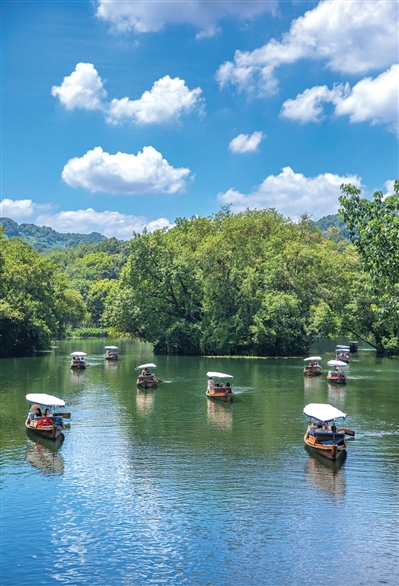 昨天上午,西湖上空蓝天白云,风光如画。 Some three million Vietnamese were affected by direct contact with dioxin in that decade.,14% of the territory of South Vietnam was exposed to this toxin, causing severe consequences for the land and nature. Five thousand square kilometers of mangrove forests were almost completely destroyed; about 10,000 square kilometers of jungle and more than a thousand square kilometers of lowland forests were affected. American troops destroyed 70% of the coconut plantations and 60% of the Gewea plantations; they also changed the ecological balance of Vietnam.,The affected areas lost 18 out of 150 bird species; nearly all amphibians and insects disappeared; the number of fish in rivers decreased, and their composition changed. The microbiological composition of soils was disturbed. Changes in the fauna resulted in the replacement of black rats, which are safe for humans, with other species that were plague carriers. Alterations in the mosquito species composition led to the introduction of malaria-carrying ones. Dioxin: A Permanently Exploding Bomb The large-scale US use of chemical warfare in Vietnam lasted until late 1971. But this war was not over for Vietnam itself, said Professor Andrei Kuznetsov, director general of the Russian Division of the Joint Russo-Vietnamese Research and Technology Tropical Center, in an interview with Sputnik.,“This is because dioxins, once inside the human body, begin to work like an HIV infection. If a person is completely healthy, they do not affect him. As soon as the human immune system weakens and any disease begins, dioxins immediately get integrated into the disease chains and start working in their own way. No one knows just how. They can cause cancer, damage to the liver, skin, respiratory system, and much more. Dioxin pathology is very diverse. And the most tragic thing is that it is inherited through mother's milk. More than a million and a half Vietnamese in the three postwar generations have suffered from it. For an extremely long time, for many generations, dioxins will continue to be passed on from women to their children. Moreover, there is no minimum permissible dose for dioxins,” says Andrei Kuznetsov.,Today, Vietnam faces the ever-present threat that children will be born with a wide variety of defects. To this day, several villages there are closed to the public, where children are born into families with various deformities. There are several specialized boarding schools where children with genetic defects live. Scientists from different countries have been studying the effects of dioxin on soil for a long time, but only in temperate and northern climates. No one has studied its impact in the tropics. There have been no studies on what happens when dioxin molecules enter the soil under tropical conditions, continued Professor Kuznetsov.,“The Joint Russo-Vietnamese Research and Tropical Technology Center is the first and only one to address this issue. It was commonly believed that dioxin molecules were insoluble. Supposedly, humus binds them and they remain in the top layer of the soil. One could bulldoze or even shovel it and burn it. But it turns out that things are different in the tropics. Dioxin molecules bind with various acids in the soil, forming new dioxin-containing molecules that become water-soluble and water-permeable. They mix with rainfall streams, sink into the soil, get transported by subsurface water, and subsequently enter wells, lakes, rivers, and seas hundreds of kilometers away from where they were sprayed. This situation persists in Vietnam to this day. There are several ‘hot spots’; places where, during the aggression, the Americans stored barrels with chemical agents. When they left Vietnam, they shot these barrels with large-caliber machine guns and left them there. For example, this happened in Da Nang, which was one of the largest US military bases. And the same happened at the US military base in Bien Hoa. These two former bases are still the largest and scariest hotbeds of contamination,” said Andrei Kuznetsov.,The expert also noted that the Americans recently have conducted a demonstrative action in Da Nang – and have now begun it in Bien Hoa – to decontaminate the soil to a depth of two meters in those places where barrels with warfare agents were stored. But they don`t check the level of dioxin contamination even within the radius of 200-300 meters from the storage sites. Meanwhile, subsurface water transports pesticides far beyond those limits.,The Mission of Joint Tropical Center The Joint Russo-Vietnamese Research and Technology Tropical Center has been studying the consequences of the US chemical war in Vietnam since its founding. In fact, it was established precisely for this work, noted Professor Kuznetsov.,“We were tasked with determining whether contact with dioxin leads to genetic changes in humans and has a detrimental effect on soil, flora, and fauna. Our conclusion - yes, it does. The results of our work were published and reported to the leadership of Vietnam’s Ministry of National Defense and Ministry of Health, together with our scientific and practical recommendations on combating various dioxin-related effects. At the same time, we noted that the most effective, global way to prevent dioxins from damaging people is to take maximum care of their health. That is, Vietnam needs to invest much more in health care than countries that have not been exposed to this toxic chemical. We cannot yet say when the effects of US chemical warfare will cease in Vietnam. After all, Vietnam is the first and only country to have been exposed to such massive amounts of poisonous substances,” Kuznetsov concluded.。 记者 陈中秋 摄今天开始,杭州又将开启一连串的阴雨天气。杭州市气象台分析称,随着台湾岛附近的低压系统逐渐北抬,受到其外围东风气流的影响,杭州转为多阵雨或雷雨的天气。具体来说,今天多云到阴,有阵雨或雷雨,部分地区中雨,雷雨时局地可伴有短时暴雨和6~8级雷雨大风等强对流天气;明天阴有阵雨或雷雨。

二 | 气温方面,今天最高气温31℃,最低气温26℃,平均相对湿度75%,看起来气温不高,但比较闷热。

三 | 大家做好心理准备,从今天开始一直到24日,杭州都有雨水影响,最近出门记得带伞。有一种高温叫“隐形高温”杭州最高气温已经连续好几天低于35℃高温线,但感受不到丝毫凉快。有网友说“凌晨3点多被热醒爬起来开空调”,连中央气象台都感叹说,“前段时间去浙江出差,没空调是真的不行”。近期虽然高温强度不强,但相对湿度较大,所以闷热感明显。中国天气网表示,33℃左右的气温加上较大的湿度,体感温度也会超过35℃,属于“隐形高温”。最近,气象部门基于通用气象体感计算公式,特别开发了一款“体感温度计算器”(打开“杭州天气”微信公众号,点击下拉菜单“气象服务”板块中的“DIY体感温度”功能,即可使用)。记者试着算了下,昨天中午11点左右,实时气温显示为33.2℃的情况下,如果站在太阳直晒的沥青路面上,体感温度高达38.6℃。如果想知道自己所处环境的体感温度,你也可以去试一下。在“不是高温,胜似高温”的日子里,我们再次提醒大家,虽然已经立秋,但杭州的夏天远没有结束,还是要做好防暑降温工作。

四 | 台风“沙德尔”冲着江浙沪来了?据中央气象台消息,今年第18号台风“沙德尔”(热带风暴级;英文名称:Saudel;名字来源:密克罗尼西亚;名称意义:密克罗尼西亚波纳佩岛传说中的将领“苏迪罗”信任的卫兵)于昨天上午在西北太平洋洋面上生成,中心附近最大风力有8级(18米/秒)。预计,“沙德尔”将以每小时15~20公里的速度向北偏西方向移动,强度逐渐增强,趋向琉球群岛以东洋面。由于距离较远,未来5天对我国海域无影响。有网友问,台风“沙德尔”会不会又是冲着江浙沪来的?目前还不能确定。据中国气象频道气象分析师信欣此前分析,它总体会先向西北方向移动,但后期路径不确定性大。临近琉球群岛时,要根据台风强度、副热带高压强度位置,以及东北一带冷槽和冷空气情况来判定。如果冷空气强,副热带高压东退就是转向去韩国或日本。如果冷空气弱,副热带高压强,也可能引导台风来我国。

五 | 另一边,南海热带扰动也已于昨天下午5点加强为热带低压,其中心位于海南省文昌市偏东方向约270公里的南海北部海面上,外围最大风力有7级(15米/秒)。

六 | 预计,该低压今日将以每小时5~10公里的速度向偏西方向缓慢移动,穿过海南岛后移入北部湾海面,强度变化不大。受其影响,这两天,华南沿海、南海、巴士海峡等海域有6~7级、阵风8~9级的大风;华南南部及浙江东部、福建东部、台湾等地有强降雨,海南西部局地累计降雨量超400毫米。正值暑假,如你和家人正计划前往上述地方,还请关注当地天气预报。
Current article:http://w6mgk.tichannangenzhuchuapin.cfd/nx1its/g9tkyy.html
Published on:13:12:31